You've seen the photos of Shibuya Crossing and the torii gates of Fushimi Inari. But what about the places between the postcards? The quiet village clinging to a mountainside, the coastal road where you're the only car for miles, the local festival that hasn't made it to Instagram yet. That's the real magic of Japan hidden gems.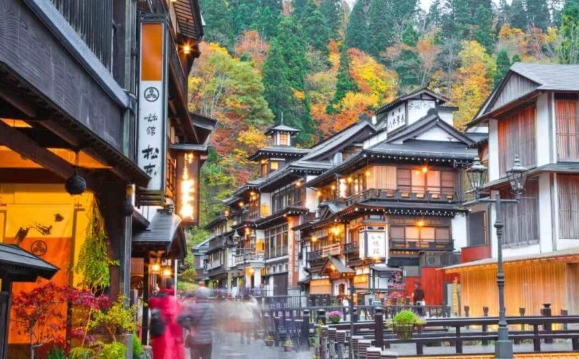
It's not about being a contrarian. It's about depth. Anyone can follow a crowd. Finding these spots requires a different map.
What's Inside This Guide?
What Actually Makes a Place a "Hidden Gem"?
Let's clear this up first. A hidden gem isn't just a less-crowded temple in Kyoto. By that definition, a 7-Eleven at 3 AM is a hidden gem. No.
A true hidden gem has three qualities:
- It demands effort. It's not served by a direct bullet train or a tour bus route from a major hotel. You might need a rental car, a local bus with a twice-daily schedule, or a good walk.
- It feels discovered, not staged. The primary audience is locals or domestic tourists. English signage is minimal or charmingly awkward. The experience isn't packaged for international consumption.
- It connects you to a specific aspect of Japan. This could be history, craftsmanship, nature, or daily life in a way that big cities simply can't.
I once spent an hour looking for a pottery village near Kanazawa, following handwritten Japanese signs down narrowing lanes. When I found it, the elderly potter seemed surprised to see a foreign face, but happily showed me his kiln. That feeling—of stumbling upon a working piece of the country, not a curated exhibit—is the goal.
How to Find Hidden Gems: A Practical Method
Forget scrolling through endless "top 10 secret spots" lists. Most are just repeats of the same five places. You need a system.
The Regional Deep Dive: Instead of picking spots, pick a region. Want wild coastlines? Look at the Noto Peninsula in Ishikawa. Want feudal history and mountain scenery? Focus on Fukushima or Gifu prefectures. Japan's 47 prefectures each have their own tourism websites, often with excellent English sections that go deeper than national portals.
Here's my process:
1. Start with a map. I use Google Maps, switch to terrain view, and look for interesting features—peninsulas, mountain ranges, lakes—away from major city clusters.
2. Consult local sources. The Japan National Tourism Organization (JNTO) site is a good start, but then I go to the prefectural tourism site. For example, the Ishikawa Prefecture website has details on Noto's salt farms and remote festivals you won't find elsewhere.
3. Search in Japanese. Use Google Translate to find the Japanese name for your interest (e.g., "pottery village" = 陶芸の里). Paste that into Google or Instagram. The results are completely different.
4. Look for transport gaps. If a place is only accessible by one infrequent bus line or requires a taxi from the station, you're getting warmer.
The biggest mistake? Trying to cram a hidden gem into a 3-day Tokyo-Kyoto whirlwind. It won't work.
Three Off-the-Beaten-Path Destinations to Build Your Trip Around
These aren't just points on a map. They're experiences that can anchor a whole trip. I've chosen ones that offer something profoundly different.
1. The Koya-Ryujin Skyline (Wakayama/Nara)
This isn't a town; it's a journey. The Koya-Ryujin Skyline is a 40-kilometer toll road that winds over the Kii Mountains, connecting sacred Mount Koya to the Ryujin Onsen area. It's one of Japan's best driving roads, but its real secret is the landscape.
You drive through a sea of clouds on clear mornings. The autumn colors here are absurdly vibrant—deep reds and yellows with zero tourist coaches. There are pull-offs with views that stretch forever. I drove it on a Tuesday in November and passed maybe three other cars in two hours.
| Info | Details |
|---|---|
| What it is | A scenic mountain toll road (approx. ¥1,500 per car). |
| Best Access | Rental car is mandatory. Start from either Koyasan or Ryujin Onsen. |
| Key Stop | Dorokyo Gorge Lookout: A short walk to a view over a dramatic, winding river canyon. |
| When to Go | Late October to early November for foliage. Avoid weekends. |
| Combine With | An overnight stay at a temple lodging on Mount Koya and a soak in Ryujin's hot springs. |
2. Ouchi-juku (Fukushima)
Step into an Edo-period post town frozen in time. Ouchi-juku's main street is lined with thatched-roof houses (called kayabuki), many now operating as restaurants, sake shops, and small museums. Unlike more famous Shirakawa-go, it feels more lived-in and less like an open-air museum.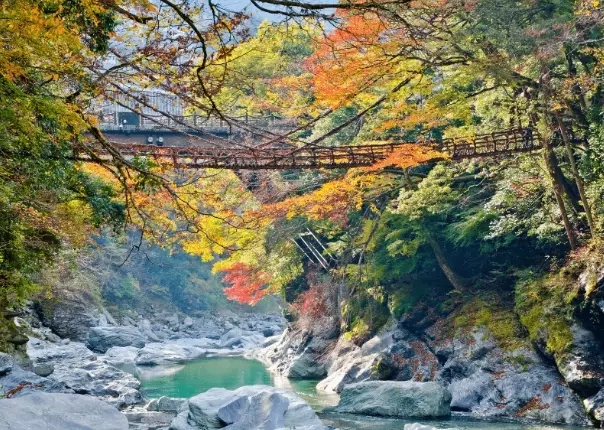
The specialty here is negisoba—buckwheat noodles you eat using a giant green onion as a chopstick. It's messy, fun, and delicious. Walk to the top of the hill at the end of town for the classic photo view looking back down the street.
It gets day-trippers, but stay late. After the buses leave at 4 PM, the town settles into a profound quiet. You can hear the creek running alongside the street.
| Info | Details |
|---|---|
| Address | Yamamoto, Ouchi, Shimogo, Minamiaizu District, Fukushima 969-5207. |
| Access | ~15 min taxi from Yunokami-Onsen Station (Tadami Line). Buses also run but check schedules. |
| Cost | Free to enter. Meals cost ¥1,000-¥2,000. Some houses charge a small fee (¥300-¥500) to enter. |
| Don't Miss | Trying negisoba, buying local sake, the small history museum in a former magistrate's office. |
3. The Noto Peninsula's Northern Coast (Ishikawa)
This is a region, not a single spot. The northern tip of the Noto Peninsula feels like the edge of the world. The Japan Sea crashes against dramatic cliffs, and traditional fishing villages operate much as they have for centuries.
Here, the gems are the activities and vistas:
- Shiroyone Senmaida: A "thousand" tiny rice terraces carved into a steep hillside facing the sea. At night, they're illuminated seasonally—a breathtaking sight.
- Morning Markets at Wajima: Not tourist bazaars, but a 1,000-year-old daily market where locals buy seafood and vegetables. Go early.
- Driving the Coastal Route: The road itself, with constant ocean views and sudden rock formations like Mitsukejima, is the attraction.
You need a car here. Public transport exists but is skeletal. The reward is a sense of space and rugged beauty you won't find in manicured gardens.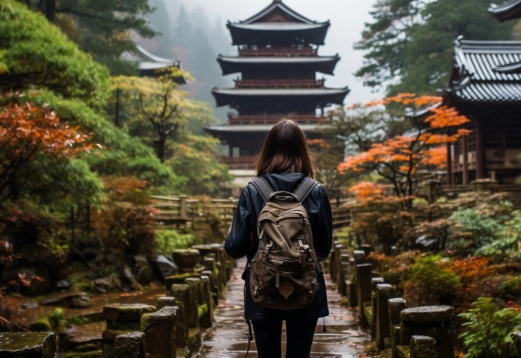
Planning Your Hidden Gem Itinerary: Tips from Experience
Okay, you're excited about these ideas. Now, how do you make it a reality without stress?
Time is your most important resource. For every hidden gem, add at least 50% more time than Google Maps suggests. Buses are late, roads are winding, and you'll want to stop constantly.
Embrace the mix. Pair 2-3 days of hidden gem exploration with 2 days in a major city for contrast and logistical ease (like pairing Noto with Kanazawa).
Booking accommodations can be tricky. Many lovely family-run minshuku (guesthouses) don't use international booking platforms. Use Japanese sites like Jalan.net or Rakuten Travel, which have English options. Or, ask your first city hotel to help call and book for you—they often will.
My last trip involved a ryokan in a hot spring village with no English menu. Dinner was a mystery course of mountain vegetables and river fish. It was the best meal of the trip precisely because I didn't know what to expect.
Be prepared for things to not go perfectly. A road might be closed. A restaurant might be unexpectedly shut. That's part of the adventure. Have a backup plan (like a convenience store meal—they're excellent in Japan).
Your Hidden Japan Travel Questions Answered
The search for Japan hidden gems isn't about collecting places. It's about resetting your travel rhythm. It's slower, a bit unpredictable, and infinitely more rewarding. You won't just see Japan; you'll feel its texture, hear its quiet spaces, and bring home stories that are uniquely yours. Start with a region that calls to you, and let the map surprise you.


Comments