Bearded Dragon Care: 7 Deadly Mistakes New Owners Make
- Date
- Reads
- 34 x
What's Inside This Care Guide
- Mistake #1: The UVB Coil Bulb Trap
- Mistake #2: Serving Salad at the Wrong Time
- Mistake #3: Choosing the Wrong Substrate
- Mistake #4: Forgetting About Hydration
- Mistake #5: Guessing Temperatures
- Mistake #6: Over-Handling a Stressed Dragon
- Mistake #7: Panicking During Brumation
- Real Questions from Real Keepers
I still remember the first beardie I brought home. Named him Spike. Dropped a hundred bucks on a "starter kit" from a big-box store, set it up exactly like the box showed, and felt pretty proud of myself. Two months later, Spike stopped eating. Then he stopped opening his eyes. A vet visit and $340 later, I learned the coil UVB bulb that came with the kit was basically a flashlight—no usable UV. That was my first hard lesson in bearded dragon care, and it wasn't in any of the care sheets I'd read online.
Since then I've kept six beardies, bred two pairs, and helped dozens of friends set up their tanks. The mistakes I see over and over are rarely the ones you'll find on a basic checklist. They're subtle, they're common, and they can take months to show up as health problems. Here's what I wish someone had told me.
Mistake #1: The UVB Coil Bulb Trap
Almost every starter kit ships with a compact fluorescent UVB coil. They're cheap, they fit standard sockets, and they produce almost zero UVB at the distances a bearded dragon actually sits from the bulb. I've measured them with a Solarmeter 6.5—a $200 tool that every serious keeper eventually buys—and at 10 inches, most coils output barely 0.5 UVI. A bearded dragon needs a UVI of 3.0 to 4.5 in its basking zone.
The fix is a linear fluorescent tube or a metal halide. The Reptisun 10.0 T5 HO and the Arcadia 12% are the two I've used for years, mounted inside the tank with a reflector hood. No screen top blocking the light. Mount them 12 to 15 inches from the basking surface. Replace them every 9 to 12 months—yes, even if they still light up, because the phosphors degrade and the UV output drops off a cliff.
My vet told me something that stuck: "A bearded dragon without proper UVB is like a human who never goes outside. They survive, but they don't thrive." That's the difference between a dragon that lives two years and one that lives twelve.
Mistake #2: Serving Salad at the Wrong Time
Here's a detail that almost no care guide mentions: timing matters. Bearded dragons are most active and have the highest body temperature in the first few hours after their lights come on. That's when their digestive enzymes work best. If you feed them salad late in the day, it sits in their gut overnight at lower temperatures and can ferment, leading to bloating and loose stools.
I feed greens in the morning—right after the lights kick on—and insects in the late morning or early afternoon. My go-to salad base is collard greens, mustard greens, and a little shredded butternut squash. No spinach, no kale as a staple (both bind calcium), no lettuce (it's mostly water).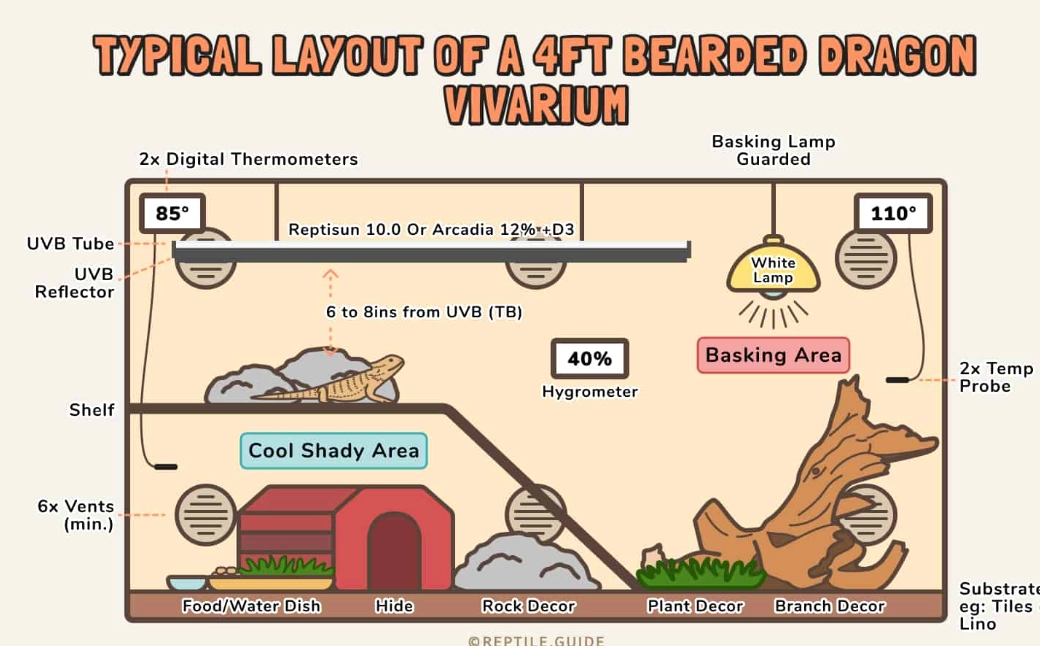
What a Good Weekly Menu Looks Like
- Monday: Collard greens + calcium dusted dubia roaches
- Tuesday: Mustard greens + grated squash
- Wednesday: Collard greens + a few superworms as a treat
- Thursday: Dandelion greens + calcium dusted crickets
- Friday: Mustard greens + bell pepper strips
- Saturday: Collard greens + dubia roaches
- Sunday: Light salad only, no insects (a rest day for the gut)
Adult beardies eat about 70% greens and 30% insects. Juveniles are the opposite—80% insects. Getting this ratio wrong is one of the fastest ways to cause gout or metabolic bone disease.
Mistake #3: Choosing the Wrong Substrate
I'm going to give you the non-consensus take here: not all loose substrate is bad. The problem is the wrong loose substrate. Play sand mixed with organic topsoil at a 50/50 ratio is what many experienced keepers use, and it allows for natural digging behavior without the impaction risk of calcium sand or crushed walnut shells.
Calcium sand is the worst offender. It clumps in the stomach, and because it's calcium-based, the dragon absorbs it and can overdose. I've seen impaction surgeries that cost over $1,200. Skip it. If you're nervous about loose substrate with a baby dragon, use paper towels until they're about 12 inches long, then switch to the sand-soil mix.
| Substrate Type | Impaction Risk | Cost (40-gallon tank) | My Verdict |
|---|---|---|---|
| Paper towels | None | $3 | Best for babies or sick dragons |
| Play sand + topsoil (50/50) | Low (if husbandry is correct) | $18 | Best for healthy adults |
| Calcium sand | High | $25 | Avoid entirely |
| Crushed walnut shells | High | $22 | Avoid entirely |
| Reptile carpet | Low | $15 | Bacteria trap; must wash weekly |
Mistake #4: Forgetting About Hydration
Bearded dragons are desert-adapted animals, but that doesn't mean they don't need water. They get most of their moisture from their food, which is why a diet of dry pellets is a problem. But even with good greens, many dragons are chronically mildly dehydrated.
How I check: gently pinch the skin on the back of the neck. If it stays tented for more than a second, the dragon is dehydrated. Another sign is sunken fat pads on the sides of the head above the eyes.
I offer a shallow water dish—large enough to soak in but shallow enough that the dragon's nostrils stay above water when it stands. I also mist the greens lightly with water before serving. A 10-minute soak in warm water once a week helps some dragons, but not all of them drink from a bowl. Some only drink when water drips onto their nose from a spray bottle. You have to figure out what yours prefers.
Mistake #5: Guessing Temperatures
"Basking spot should be 100 to 110 degrees." You've read that everywhere. But the number that actually matters is the surface temperature of the basking rock, not the air temperature. I use an infrared temp gun (the Etekcity one costs about $20) to check the actual rock surface. Air thermometers hanging on the glass tell you almost nothing useful.
Here's the setup I run: a 100-watt halogen flood bulb on a dimmer, positioned over a slate tile. The tile surface reads 105°F. The cool side of the tank reads 80°F. The dragon moves between these zones as needed—that's the whole point of a temperature gradient. If your dragon is glass-surfing or spending all day on the cool side, the basking spot is probably too hot. If it never leaves the basking spot, the cool side might be too cold.
The weird trick I learned from a longtime breeder: Put a digital probe thermometer on the basking rock and leave it there for 24 hours. Watch the numbers the dragon actually experiences, not the numbers on a dial. That rock might be 115°F even when the air two inches above it is 98°F.
Mistake #6: Over-Handling a Stressed Dragon
New owners love to handle their new dragon constantly. I get it. But a bearded dragon that's barely a month into a new home is running on stress hormones. Handling it every hour is like someone picking you up constantly during your first week at a new job.
My rule: leave them completely alone for the first 5 to 7 days except for feeding and spot cleaning. Then start with 5-minute handling sessions once a day. Sit on the floor with the dragon on your lap—not the sofa, because a startled dragon can run and fall. A fall from three feet can crack a rib. I had a friend whose beardie slipped off her shoulder and fractured a leg. The vet bill was $600.
Watch for stress marks—dark, jagged patterns on the belly and beard. If those show up while you're holding them, put them back. They're telling you they've had enough.
Mistake #7: Panicking During Brumation
Every fall, my inbox fills up with the same message: "My bearded dragon stopped eating and has been sleeping for three days. Is it dying?" Probably not.
Brumation is a slow-down period triggered by shorter daylight hours and cooler temps. Beardies can sleep for days or weeks, eat nothing, and come out fine—if they went into it healthy and hydrated. The mistake is panicking and force-feeding, which can cause food to rot in the gut.
What I do: if a dragon goes down for brumation, I still leave the lights on the same schedule for a week. I offer water. I weigh them every two weeks. If they lose more than 10% of body weight, that's a vet trip. If they're maintaining weight, let them sleep. My male, Frank, brumates for about 8 weeks every winter. He pops his head out one morning and acts like nothing happened.
For a full deep-dive on brumation, the Reptifiles bearded dragon care guide is the most thorough resource I've found—that's the site I refer friends to when they ask basic care questions, because it's updated regularly and doesn't recommend outdated practices.
Real Questions from Real Keepers
Facts and product recommendations in this article were verified through my own use of a Solarmeter 6.5, infrared temp gun, and vet records from my personal dragons, cross-referenced with published husbandry guidelines from the Reptifiles care guide and the Association of Reptilian and Amphibian Veterinarians.

Related
Signs of Sick Reptile: 12 Warning Signs Owners Miss
What are the early signs of a sick reptile that most owners overlook? From subtle weight loss to odd basking habits, here are 12 warning signs a seasoned keeper checks daily.

Best Substrate for Reptiles: Avoid Dangerous Mistakes
What is the best substrate for reptiles that won't cause impaction or mold? I tested 12 options in my own collection. Here's what actually holds humidity, stays clean, and keeps your animal safe.
Leopard Gecko Setup: The Complete Habitat Guide
Struggling to get your leopard gecko setup right? Learn exact temperatures, substrate choices, and the three hides every terrarium needs to avoid costly mistakes.
Comments