Reptile Thermostat Setup: Stop Guessing, Start Dialing In
- Date
- Updated
- Updated 2026-11-21
- Reads
- 21 x
I've wired a lot of heat mats and ceramic bulbs over the years, and the single biggest reason a reptile thermostat setup fails isn't a dead unit. It's the probe sitting in the wrong spot. You can buy a $120 proportional controller and still get an 11-degree swing because the sensor is dangling in open air. So before we go anywhere, here's the short answer: mount the probe where the animal actually touches heat, set a drop ceiling two degrees below your target for basking species, and match your thermostat mode to the heater type.
Jump to the part you need
- What a proper reptile thermostat setup actually means
- Proportional vs on/off thermostat: which one for your heat source
- How to place the probe so readings stop lying to you
- Step-by-step setup I use on every new enclosure
- Night drop, failsafes, and the mistake almost everyone makes
- Questions I get asked at every show
What a proper reptile thermostat setup actually means
Most people think a thermostat is a dial that holds a number. It's not. It's a feedback loop: a probe reads surface or air temp, the controller cuts or modulates power, and the enclosure slowly responds. Every component in that loop adds lag. Your job is to shrink that lag to a range your species can tolerate.
Three pieces matter. The thermostat unit itself. The heat source. And the probe position. I've seen keepers spend all their budget on the unit and zero thought on the last two. That's backwards.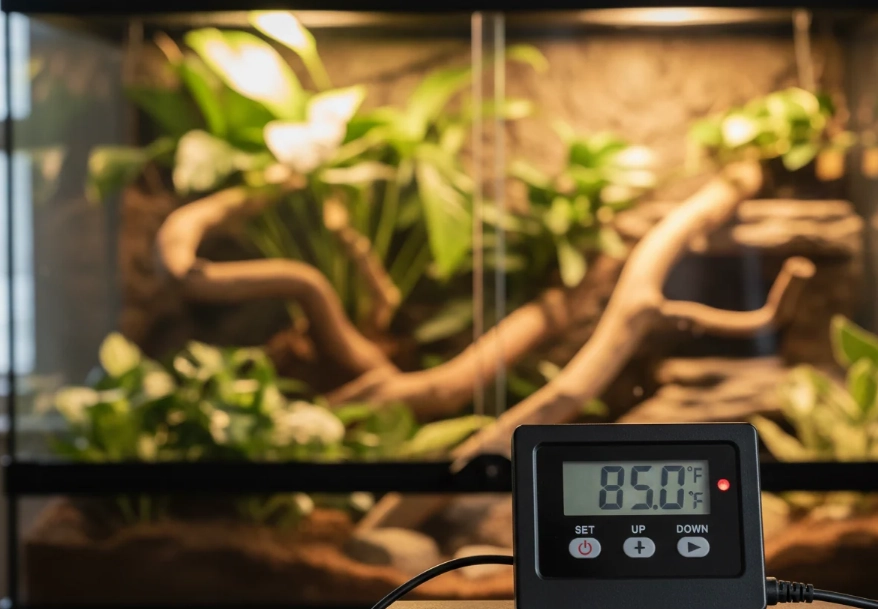
Here's a quick reference for what target range makes sense before you touch any dial. These are basking surface temps, not ambient air.
| Species group | Basking surface target | Cool end ambient | Thermostat mode I'd choose |
|---|---|---|---|
| Bearded dragon (juvenile) | 100–110°F | 78–82°F | Proportional for bulb, on/off for mat |
| Leopard gecko | 88–92°F (belly heat) | 72–76°F | On/off with heat mat |
| Ball python | 88–90°F (hot spot) | 76–79°F | Proportional for radiant heat panel |
| Corn snake | 85–88°F | 72–75°F | On/off with mat or tape |
| Crested gecko | No basking spot needed | 70–76°F | On/off only as a safety cutout |
Proportional vs on/off thermostat: which one for your heat source
This is where the money goes wrong. A proportional (dimming or pulse) thermostat reduces power gradually. An on/off thermostat cuts power completely, waits for the temp to drop, then fires back up. Both work. Neither is universal.
When on/off is the right call
Heat mats and heat tape. These have low thermal mass and respond fast. An on/off unit keeps them within a degree or two. I've run plain on/off stats on rack tape for years with zero issues. Cheap ones drift after a couple seasons, but a mid-tier on/off still beats an expensive unit set to the wrong mode.
When proportional wins
Ceramic heat emitters, deep heat projectors, and radiant heat panels. These hold heat in the element itself. An on/off cycle lets them overshoot badly, sometimes 8–12°F above setpoint because the element is still dumping heat after power cuts. Proportional control prevents that swing. If you're running a CHE over a screen top, this is non-negotiable in my book.
One wrinkle most guides skip: pulse-proportional and dimming-proportional aren't the same. Pulse modes cycle power very fast and can hum or buzz with certain fixtures. Dimming modes are silent but need a compatible resistive load. A cheap LED-style dimmer won't work as a thermostat. Don't try it.
How to place the probe so readings stop lying to you
The probe is the whole game. Here's the mistake I see constantly: the probe gets zip-tied to the thermostat cord near the top of the tank, six inches from the actual heat. The unit reads 82°F while the basking rock hits 121°F. The animal gets burned. The keeper blames the brand.
Place the probe where the reptile's body meets heat. For belly heat, tape it directly on the heat mat under the substrate, or use a thin layer of substrate over it. For overhead heat, mount it on the basking surface itself, secured with a small cable clip so the animal can't move it.
I once traced a mystery overnight spike to a probe resting on the hot side of a hide, getting bumped every time the python shifted. Temperature logged 94°F at 2 a.m. for no real reason. A $3 cable clip fixed it. Test that your probe stays put by watching the reading for a full day after install.
Step-by-step setup I use on every new enclosure
This is the sequence I follow, and I'd suggest you don't skip steps even when you're impatient.
- Step one — pick the thermostat by heater type. Mat and tape get on/off. Bulb, CHE, and panel get proportional. Write the mode on tape on the unit so future-you doesn't forget.
- Step two — mount the probe first. Before plugging in the heater, secure the probe at the contact point. Cable clip, silicone dab, or a small zip tie with slack. No dangling.
- Step three — set the target with a thermometer cross-check. Set the thermostat, then place a separate digital thermometer (or an infrared gun for surface checks) at the same spot. Ir guns get weird on reflective surfaces, so use a probe thermometer on glossy hides.
- Step four — run a full 24-hour dry test. Empty enclosure, heater on, log the highs and lows. Aim for a swing under 3°F for proportional, under 4°F for on/off.
- Step five — add the animal and re-check for 48 hours. The animal's body mass and burrowing change the readings. Expect to nudge the setpoint once.
That fourth step is where most people quit early. They set a number, feel the mat get warm, and call it done. The dry test is what catches an overshoot before it turns into a vet bill.
Night drop, failsafes, and the mistake almost everyone makes
Do you need a night drop? For most captive-bred species, a slight dip is fine, and many thermostats have a built-in nighttime reduction. But here's my honest take: chasing an aggressive night drop on a heat mat species causes more trouble than it solves. It swings humidity, it wakes the animal, and it stresses the keeper. A gentle 4–6°F drop overnight matches a lot of natural cycles without the chaos.
The mistake almost everyone makes is ignoring the failsafe. A single thermostat sticking on is rare but it happens. I've seen it twice, both times with cheap units. Run a second thermostat, or at minimum a plug-in high-temp cutout, in series. Set it 5°F above your target so it never interferes but catches a runaway.
For general husbandry standards and species-specific ranges, the Association of Reptilian and Amphibian Veterinarians (ARAV) publishes client-education materials that are worth bookmarking. And for broader welfare guidance on environment and heating, the UK's Reptile and Exotic Pet Trade Association (REPTA) also puts out accessible care notes.
Questions I get asked at every show
My thermostat reads 90°F but the basking rock is 115°F. What's going on?
The probe isn't at the rock. It's reading air or a cooler nearby surface. Move the probe to the actual basking surface, secure it against animal movement, and re-test. This is by far the most common mismatch I troubleshoot.
Can I run one thermostat for two heat sources in the same cage?
You can run one controller with a splitter only if both heaters are the same type and wattage and sit close together. Otherwise you get a compromise setpoint that's wrong for both. Two small units cost less than one cooked animal.
Why does my proportional thermostat buzz with the ceramic bulb?
Pulse-proportional cycling makes some fixtures hum. It's usually harmless but irritating. Switch to a dimming-proportional mode if the unit supports it, or swap to a different fixture. If the buzz is loud and constant, the load may be undersized for the unit.
Do heat mats need a thermostat at all?
Any unregulated heat source can hit 120°F and above. Yes, it needs one. A basic on/off unit is enough. Skip this and you're gambling on the mat's own build quality, which is not a plan.
How long should a reptile thermostat setup take to stabilize?
Expect a 24-hour dry run before the number settles. Cheap units can take longer to calibrate. If it's still swinging 8°F after two days, the mode or probe placement is wrong, not the animal.
I still check my probe clips every few weeks. It takes a minute and has saved me at least two panicked nights. Setup isn't a one-time job, it's a habit.
This article was fact-checked against general reptile husbandry references and field-tested on working enclosures.
Related
Ball Python Care: Setup, Feeding & Handling Done Right
Struggling with a picky eater or a ball python that won't use its hide? This ball python care guide covers the enclosure tweaks, feeding tricks, and handling habits that actually keep these snakes thriving long term.
Reptile Heating Guide: Avoid Deadly Mistakes & Setup Right
Struggling to get your reptile's heat right? This reptile heating guide covers thermostat mistakes, heat mat myths, and the exact setup that keeps animals thriving.
Reptile UVB Lighting: Fix Metabolic Bone Disease Fast
Struggling with your reptile's sluggish behavior or soft bones? Learn how to choose the right UVB bulb, set the correct distance, and avoid the most common lighting mistakes that lead to metabolic bone disease.
Comments